

Yum! Brands Sells Pizza Hut for $2.7 Billion, Ending Nearly Five Decades of Ownership
A private equity firm and Yum China will split the iconic pizza chain as the brand attempts a turnaround under new leadership

After years of sliding sales, closing locations, and a formal strategic review that signaled a sale was likely inevitable, Yum! Brands made it official on June 16, 2026. The Louisville, Kentucky-based restaurant company announced that it has entered into definitive agreements to sell Pizza Hut for $2.7 billion in the aggregate, subject to purchase price adjustments. The deal effectively ends a corporate relationship that dates back nearly half a century and reshapes one of the most recognizable fast-food portfolios in the world.
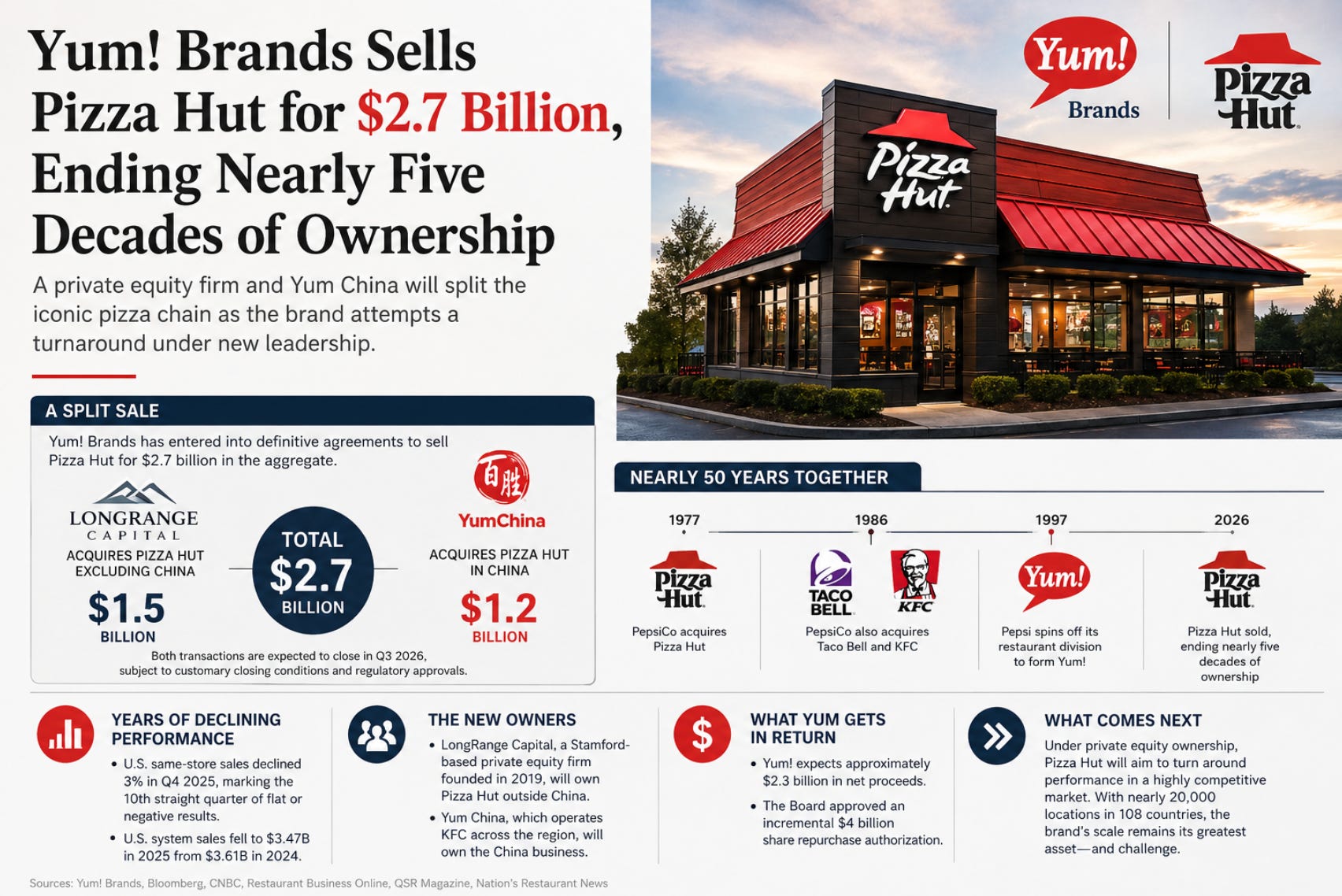
A Split Sale
Private equity firm LongRange Capital will acquire Pizza Hut excluding China for $1.5 billion, while Yum China Holdings will buy the rest of the business for $1.2 billion. Yum! expects both transactions to close in the third quarter of 2026, subject to customary closing conditions including required regulatory approvals. Following the close, Yum! will no longer report on the Pizza Hut division.
The structure of the deal reflects the divergent performance of Pizza Hut across its two largest markets. Although sales have declined in the United States, Canada, and Europe, Pizza Hut has continued to grow in China. In 2024, U.S. sales accounted for 46% of the brand’s revenue; in 2025, that figure fell to 40%. Separating the China business under Yum China, which already operates KFC across the region, makes strategic sense given its relative strength there.
Decades of History
The deal severs Pizza Hut’s decades-long ties to Taco Bell and KFC, its sister brands in Yum’s portfolio. PepsiCo bought Pizza Hut in 1977, marking the beverage giant’s entry into the restaurant business. By 1986, it also owned Taco Bell and KFC. When Pepsi spun off its restaurant unit in 1997, the holding company was dubbed Tricon Global Restaurants, later renamed to Yum. For the brand, this sale marks the first change in ownership in nearly 50 years.
Years of Declining Performance
The sale did not come as a surprise to anyone watching Pizza Hut’s numbers. Same-store sales declined 3% in the U.S. in the fourth quarter of 2025, marking its ninth straight decline and tenth straight quarter of flat or negative results in the key metric. Since the first quarter of 2022, Pizza Hut’s same-store sales have declined in 12 of 16 quarters.
The chain’s problems go beyond any single quarter. In the first quarter of 2026, U.S. same-store sales fell 4% and systemwide sales declined 6%. For fiscal 2025, comps dropped 5% and systemwide sales decreased 8% following another year of negative results in 2024. Meanwhile, the chain’s unit volumes are the lowest among the four big pizza chains, including Domino’s, Little Caesars, and Papa Johns, by about $200,000 per year.
The U.S. footprint has been contracting as well. Pizza Hut’s U.S. system sales last year declined to $3.47 billion from $3.61 billion at the end of 2024, while its global unit count fell to 19,974 from 20,225 at the end of 2024. Earlier this year, the company announced it would close 250 domestic locations in the first half of 2026 as part of a restructuring initiative called “Hut Forward.”
The broader pizza category has been brutal across the board. Many consumers have been avoiding fast-food restaurants due to high prices, which have increased by roughly 47% over the past decade. Delivery has also become a friction point, with customers opting to pick up orders in person to save money rather than pay elevated delivery fees. Pizza Hut, heavily reliant on delivery, has felt that shift acutely.
The New Owners
LongRange Capital is a Stamford, Connecticut-based private equity firm founded in 2019 by Bob Berlin, a former investment executive at The Baupost Group who previously oversaw investments that included Arby’s. The Arby’s connection is notable given that turnaround story’s relative success in repositioning a struggling legacy brand.
Yum Brands CEO Chris Turner said Pizza Hut will be “well positioned for future growth with ownership that brings deep expertise in the restaurant industry.” Bob Berlin echoed the optimism, saying he looks forward to working with Pizza Hut’s executive team and franchisees to drive the brand’s next phase of growth, though LongRange has not yet disclosed specific operational plans.
What Yum Gets in Return
For Yum! Brands, the transaction is a significant capital event. Yum! expects to receive approximately $2.3 billion of net proceeds after taxes, closing adjustments, and transaction-contingent fees, excluding a potential earn-out. Concurrent with approval of the transactions, Yum!’s Board of Directors approved an incremental $4 billion authorization for the repurchase of common stock.
Shedding Pizza Hut also allows Yum to sharpen its focus on Taco Bell and KFC, both of which have delivered meaningfully stronger results in recent years. Following a comprehensive review of strategic options that commenced in November 2025, Yum!’s leadership team and Board determined the sale provides the strongest path to maximize shareholder value while providing Pizza Hut an ownership structure tailored to its distinct markets and long-term priorities.
What Comes Next
The road ahead for Pizza Hut under LongRange will not be easy. The U.S. pizza segment remains intensely competitive, and the brand’s domestic unit economics are under pressure. But private equity ownership has historically brought the kind of focused, operationally intensive management that struggling consumer brands sometimes need, particularly when they are no longer a priority within a larger conglomerate.
At the end of 2025, Pizza Hut had nearly 20,000 locations across 108 countries and territories and reported $12.8 billion in annual system sales. The scale is still there. Whether LongRange can convert that global footprint into a revitalized brand depends on decisions, investments, and consumer trends that will play out over the next several years.
For now, the red roof is under new management. The question is whether that changes anything.