

The Transparency Brand Sold Its Soul to Shein. Now What?
The acquisition of Everlane is less a business story than a verdict on an era.

The news broke on a Sunday morning, in a note sent to Everlane shareholders: the brand that built its identity on “radical transparency” was being sold to Shein, the Chinese ultra-fast fashion platform that has come to represent everything Everlane claimed to stand against. The deal, brokered by majority owner L Catterton and approved by the board that same weekend, values Everlane at $100 million. Those with common stock will not receive a payout.
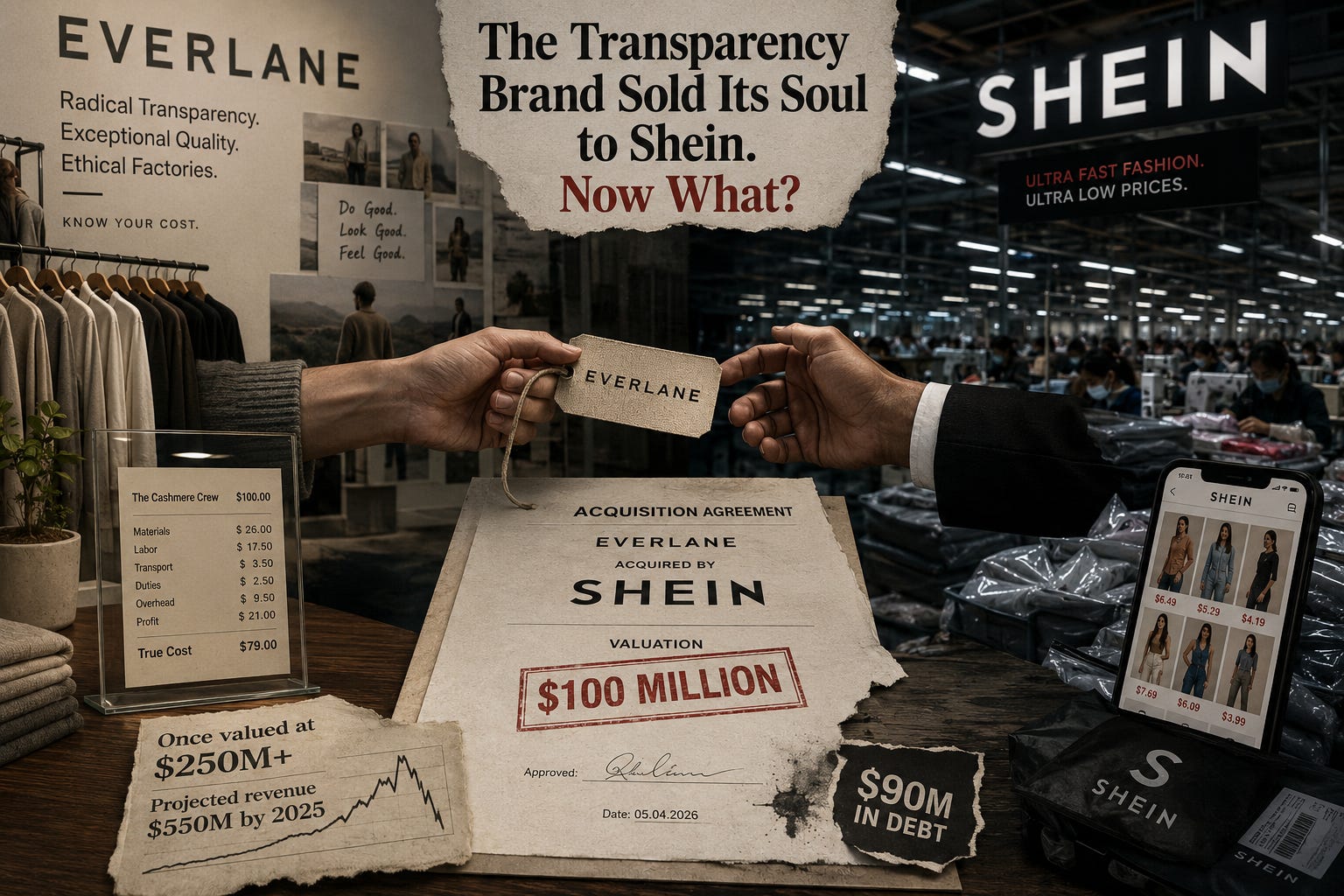
The number alone tells a brutal story. Everlane once commanded a valuation north of $250 million, with projected revenues approaching $550 million by 2025. Now it has been absorbed at a steep discount, largely to cover a reported $90 million in debt. But the meaning of this acquisition goes far beyond one company’s balance sheet. The Shein-Everlane deal is a reckoning for an entire philosophy of retail.
The idea that built Everlane
Michael Preysman and Jesse Farmer founded Everlane in 2010 on a pledge to publish the per-unit costs of its garments alongside retail prices, a practice the company trademarked under the phrase “radical transparency.” The brand gained traction quickly, finding a loyal audience among urban millennials who wanted to feel good about what they wore and what they paid for it. The proposition was elegant: quality basics, honest pricing, and a clean conscience.
For a moment, it worked. Everlane became a darling of the direct-to-consumer boom, a model for how a modern brand could disrupt traditional retail by going direct to the customer and leading with values. Its minimalist aesthetic and plainspoken pricing page became a reference point for a generation of brands that wanted to sell products as a form of self-expression, where buying a cashmere sweater could also be a small act of ethical citizenship.
Then reality crept in.
The slow collapse of the ethical DTC model
Watchdogs accused Everlane of greenwashing, charging that the company was less than forthcoming about its supply chain and the sources of its raw materials. Sales slumped during the work-from-home pandemic era, when the brand’s core product, polished office staples and going-out basics, suddenly had nowhere to go. The clean aesthetics that had once felt fresh started to look indistinguishable from dozens of competitors offering similar products at lower prices.
Everlane clung to its direct-to-consumer identity long after the model began struggling, maintaining virtually no wholesale partners for years. It finally launched on Amazon in early 2026, far later than competitors who had long since diversified their distribution. The brand had also resisted the move toward retail partnerships that helped peers like Glossier and Allbirds survive, before those brands too began contracting.
The brand’s troubles were not unique. Allbirds, another millennial-era DTC sustainability brand, kept reporting net losses, losing $20.3 million in the third quarter of 2025 alone. It has since pivoted away from footwear entirely, selling that business for $39 million, less than one percent of its previous $4 billion valuation. The era of buying a product because of what it said about you was giving way to something harder to argue with: price.
What Shein gets from this deal
For Shein, Everlane is not a transformative acquisition. The brand is too small and too diminished to meaningfully shift Shein’s revenue picture. What Shein gets instead is something more valuable in the short term: a story to tell investors. Shein has been preparing for a public offering and has faced persistent scrutiny over labor practices and environmental impact. Owning a brand with premium, sustainability-coded associations, however battered those associations have become, offers something Shein has struggled to manufacture on its own: legitimacy.
This is a reputation play as much as a retail play. By adding Everlane to its portfolio alongside other Western acquisitions, Shein can present itself to analysts and regulators as a diversified fashion group rather than a single-channel ultra-fast platform. Whether that narrative holds up under scrutiny is another question. The irony of a brand built on transparency being absorbed by a company criticized for opacity is not lost on anyone watching.
What it means for fashion more broadly
The reaction to this deal has been visceral. Loyal customers feel betrayed. Industry observers are using words like “shocking” and “selling out.” One shopper outside Everlane’s San Francisco location described Shein as far more exploitative. The phrase “Everlane is selling out”, the headline Puck News used when breaking the story, was chosen deliberately. It lands because it is true in every sense of the term.
But the louder signal here is structural. In 2026, demand for products from brands that emphasize sustainability as a core differentiator is simply too low among a wider consumer base to sustain venture-scale growth. That is a hard lesson. It suggests that sustainability-as-brand-identity was always a more fragile proposition than it appeared. Consumers who said they wanted ethical fashion did not always prove willing to pay a premium for it consistently, especially when squeezed by inflation and surrounded by cheaper alternatives.
As one fashion educator put it, consumers did everything right: they researched, paid more, and extended trust. But the market did not reward that behavior enough to keep these businesses alive. That is not an argument against ethical consumption. It is an argument that ethics must be embedded more deeply in product and operations, not just in marketing.
The end of an era
The Everlane story is the DTC dream in miniature: a bright founding vision, genuine early momentum, a period of values drift and operational struggle, and a quiet capitulation to the very forces it once defined itself against. Selling to Shein, a company long criticized for opacity in its supply chain, underscores the contradiction at the heart of this deal and raises a broader question about what happens to brand values when they collide with the pressures of scale, competition, and shareholder expectations.
The answer, it turns out, is that they get sold for $100 million on a Saturday.
For retail, the lesson is not that ethics do not matter. It is that ethics alone cannot be a business model. Brands that survive the next decade will need to embed their values in pricing, operations, and product in ways that consumers can feel, not just in a trademarked phrase on a website. The brands that treat sustainability as a differentiator will keep struggling. The ones that treat it as a baseline, a cost of doing business rather than a selling point, may fare better.
For fashion, the lesson is colder still. Even the most principled brands are not immune to the gravity of the industry they exist within. The question now is whether Everlane’s story inspires others to build more durable versions of the same vision, or whether it quietly discourages anyone from trying. Given the current market, that is not a rhetorical question. It is the most important one the industry needs to answer.