

Shrink Is Stealing Your Margin
How AI and RFID Are Rewriting the Loss Prevention Playbook

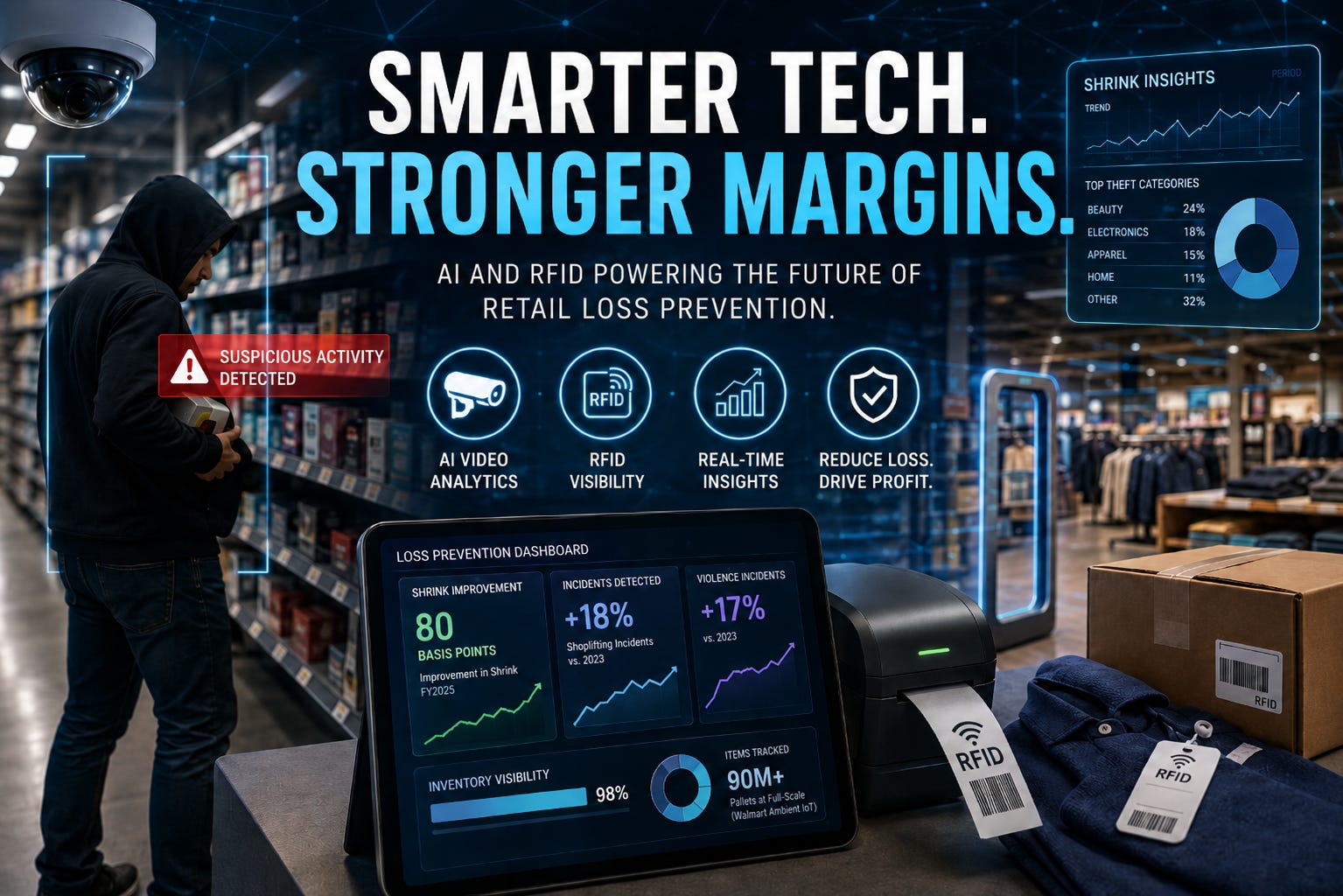
Retail shrink is one of the industry’s most stubborn margin killers. The National Retail Federation’s Impact of Retail Theft and Violence 2025 report, published in October 2025 and based on surveys representing $1.3 trillion in annual retail sales (25.1% of total U.S. retail), documented an 18% increase in shoplifting incidents in 2024 versus 2023. Violence during theft events rose 17% in the same period. Organized retail crime groups are expanding into phone scams, digital fraud, and cargo theft at scale.
The technology response is now moving from pilot to enterprise deployment. AI-powered video analytics, exception reporting, and predictive systems are being deployed by the country’s largest retailers. RFID is scaling globally, with the retail segment alone representing a $14.5 billion market in 2025 on its way to $15.86 billion in 2026. Walmart launched the largest ambient IoT deployment in retail history in October 2025. Dollar General reported an 80 basis point full-year shrink improvement in fiscal 2025. Target confirmed inventory shrink returned to pre-pandemic levels. Kroger’s CFO credited AI-enabled technology directly with measurable shrink progress on its Q1 2025 earnings call.
This report assembles only verified, sourced facts from 2025 and 2026 earnings calls, trade shows, and published research. No pre-2025 statistics are used.
Section 1: The Threat Landscape
What the NRF’s Report Actually Said
The National Retail Federation’s Impact of Retail Theft and Violence 2025 was released in October 2025 and is now the primary authoritative benchmark for the U.S. retail theft environment. The NRF discontinued its 32-year annual shrink report in 2024 due to methodology concerns, replacing it with this more targeted study of theft and violence patterns. The 2025 edition surveyed senior loss prevention executives at 70 retail companies representing 168 brands and $1.3 trillion in annual sales, or approximately 25.1% of total U.S. retail.
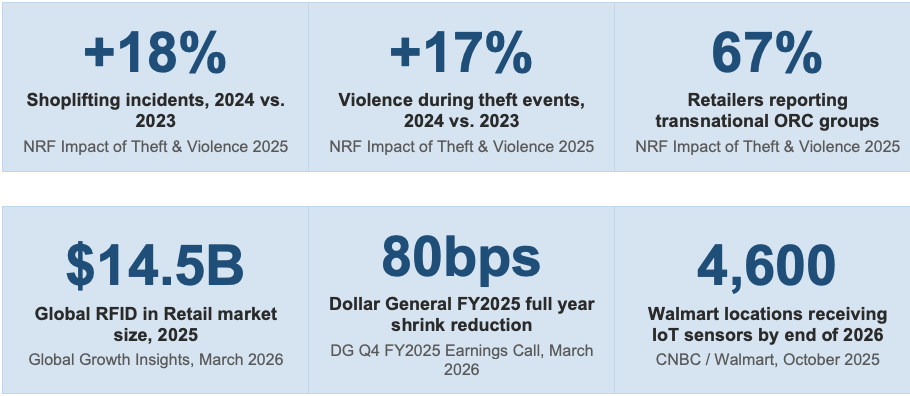
The headline findings from the 2025 report:
• 18% increase in the average number of shoplifting incidents per year in 2024 versus 2023.
• 17% increase in threats or acts of violence during shoplifting or theft events over the same period.
• 16% increase in incidents involving the threat, display, or use of a weapon during theft events.
• 67% of retailers reported involvement of transnational organized crime groups in thefts against their companies in the prior year.
• More than half of retailers surveyed reported increases in phone scams (70%), digital and e-commerce fraud (55%), shoplifting and merchandise theft (52%), and cargo or supply chain theft (50%) being conducted by ORC groups over the prior 12 months.
• 91% of respondents said that violence-related theft has required them to increase employee training on workplace violence.
• Combined 19% increase in shoplifting and merchandise theft incidents recorded in 2024, per NRF’s ORC data page.
“Retailers are contending with rising levels of theft, fraud and violence, while continuing to refine security measures, utilize technologies and partner with law enforcement in efforts to curtail loss across the retail landscape.” — David Johnston, NRF VP for Asset Protection and Retail Operations, October 2025
Organized Retail Crime: A Structural Escalation
The 2025 NRF report documents a structural shift in ORC operations beyond physical store theft into what the NRF describes as more sophisticated forms. ORC groups are diversifying their criminal portfolios, exploiting vulnerabilities across the entire retail ecosystem, from the supply chain through digital channels. The NRF is actively supporting the Combating Organized Retail Crime Act of 2025 (S. 1404 / H.R. 2853), introduced in Congress in 2025, which would establish a new Organized Retail and Supply Chain Crime Coordination Center to align federal, state, and local law enforcement efforts. Eighty percent of retailers surveyed view federal legislation as a necessity to effectively combat ORC.
The AI Loss Prevention Adoption Gap
A February 2025 study by loss prevention technology company Auror found that only 38% of retailers currently use AI-based prescriptive analytics for loss prevention, but 50% say they plan to implement it within the next one to three years. This gap represents the central opportunity in the loss prevention technology market heading into 2026 and beyond.
Section 2: AI in Loss Prevention - What Is Deploying Now
AI-Powered Video Analytics: From Reactive to Real-Time
Traditional CCTV systems record footage that loss prevention teams review after incidents occur. AI-powered video analytics platforms change the operating model fundamentally: cameras analyze live feeds continuously, flagging behaviors associated with theft in real time. Retailers at the NRF Big Show 2026 in January saw this transition described explicitly in the conference’s dedicated loss prevention track, where the theme was ‘from reactive CCTV to intelligent, store-wide visibility.’
At NRF 2026 (January 11 to 13, New York City), Direct Source demonstrated in its booth AI-powered self-checkout and computer vision-based loss prevention solutions developed in partnership with Honeywell. The demonstrations included fully AI-enabled self-checkout, computer vision loss prevention, and self-service returns that recognize customer intent and automate the process at the point of interaction. Sensormatic Solutions, in its NRF 2026 pre-show press release (January 7, 2026), launched its Category-Level Shrink Insights product, which uses Acousto-Magnetic technology to identify top theft categories and extend existing EAS investments into an intelligent LP platform. The company also showcased its Orbit AI and Video AI solutions with Re-ID technology, enabling unique visitor tracking, shopper path analysis, and employee exclusion from people counts.
AI at Point of Sale: Some Trends
Kroger provided some of the most direct on-record AI-shrink attribution from any major retailer in 2025. On its Q1 2025 earnings call (quarter ending May 24, 2025), SVP and CFO David Kennerley stated:
“We’ve seen good progress around shrink. What we really attribute this to is we’ve made some investments in some AI-enabled technology and deployed new processes around that technology.” — David Kennerley, SVP & CFO, Kroger Q1 2025 Earnings Call, June 2025
On its Q2 2025 earnings call in September 2025, Chairman and interim CEO Ron Sargent further committed to acceleration: “Accelerating our AI efforts is a natural step for Kroger, given our long history of leadership in data and machine learning.” He added: “Where we’ve implemented AI in different parts of the organization, we’re seeing results with more competitive pricing, shrink improvements and faster fulfillment.” Kroger also confirmed it was expanding AI from loss prevention applications into sales optimization, particularly for seasonal items, using the same underlying technology platforms.
Home Depot: Computer Vision at Self-Checkout via Google Cloud
Home Depot is deploying AI-driven computer vision technology across its store network in partnership with Google Cloud. The initiative targets two operational areas: asset protection at self-checkout lanes and on-shelf product integrity. The system uses in-store cameras to analyze video feeds in real time, identifying missed scans and suspicious behavior patterns at self-checkout. Home Depot’s loss prevention approach, reported by industry analysts in 2025, pairs the computer vision layer with its existing store infrastructure rather than requiring wholesale equipment replacement.
AI Adoption Trends at NRF PROTECT
At NRF PROTECT 2025, held at the Gaylord Texan Resort in Grapevine, Texas in June 2025, Sensormatic Solutions announced machine-learning enhancements to its Shrink Analyzer application, including Sweetheart Detection (identifying collusion between cashiers and accomplices) and a Shrink Confidence Score designed to help LP teams prioritize which incidents to investigate. The conference’s general theme, reflected across vendor booths and panel discussions, was the convergence of formerly standalone tools: AI video, RFID, EAS, and POS exception reporting were increasingly being positioned as integrated platforms rather than independent systems. As Mike Lamb, former VP of Asset Protection at Kroger, Walmart, and Home Depot, stated at an industry event: “No one solution as a standalone is going to be the answer in the future. When you can bring these solutions together in one package for a retailer, then you’re really gaining significant ground on intelligence, on evidence gathering, on law enforcement partnerships.”
Section 3: RFID - Scale, Market, and Real Deployments
The RFID Market
The global RFID in Retail market reached $14.50 billion in 2025 and is projected to grow to $15.86 billion in 2026, according to Global Growth Insights (March 2026). The broader global RFID market across all sectors was valued at approximately $16.73 billion in 2025, with the retail sector accounting for approximately 35% of global RFID adoption, the largest single end-use vertical. North America accounts for approximately 35 to 37% of the global RFID market. The market is growing at a compound annual growth rate of approximately 9 to 13%, depending on the segment measured, reflecting RFID’s transition from experimental technology to mainstream retail infrastructure.
Key 2025 and 2026 adoption metrics:
• 64% of retailers report improved inventory accuracy and reduced stockouts after adopting RFID technology (Business Research Insights RFID in Retail Market Report, 2026).
• 61% of RFID implementations globally are linked to inventory tracking processes.
• 68% of RFID deployments involve tagging individual retail items or packaging units for real-time product movement tracking.
• 58% of RFID systems are now integrated with cloud analytics for real-time inventory and customer tracking.
• Around 61% of large retail chains globally are investing in RFID-enabled inventory tracking systems.
• 55 billion passive RFID tags are expected to be sold globally in 2025, up from 50 billion in 2024.
• Retail apparel is forecast to account for 64% of RFID tag volume in 2025.
Walmart: The Largest Ambient IoT Deployment in Retail History
In October 2025, Walmart announced and began scaling the largest-ever deployment of ambient IoT technology in the retail sector, in partnership with San Diego-based Wiliot. The initiative uses millions of battery-free Bluetooth sensors embedded in products and pallets to capture real-time location, temperature, humidity, and dwell time data, feeding into Walmart’s AI systems for inventory optimization, cold chain compliance, and shrink reduction.
Key verified facts from Walmart’s October 2025 announcement:
• 500 Walmart locations were active with the ambient IoT sensors by end of 2025.
• Full national expansion targeting all 4,600 Walmart Supercenters and Neighborhood Markets by end of 2026.
• More than 40 distribution centers are included in the rollout.
• At full scale, the system will track an estimated 90 million pallets of inventory.
• The sensors harvest ambient energy from radio waves, light, motion, and heat, eliminating battery replacement costs.
• Walmart’s SVP of Transformation and Innovation Greg Cathey stated: “With Wiliot’s ambient IoT technology, coupled with our AI systems, we’re not only optimizing our supply chain to make faster, smarter inventory decisions, but we’re also tackling one of the hardest problems in retail: knowing exactly what we own and where it is at any given moment.”
• Early deployment results include elimination of manual inventory tasks and automated alerts enabling faster associate response to inventory discrepancies.
“This data provides proof of delivery, improves replenishment decisions, and lets us know where our items are in real time. By combining continuous sensing with AI, we’re moving from probabilistic predictions to precision decision-making.” — Greg Cathey, SVP Transformation & Innovation, Walmart, October 2025
RFID at NRF Big Show 2026
RFID was a central technology focus at NRF Big Show 2026 in January. Nedap invited attendees to tour live RFID implementations at Tecovas and Levi’s NYC flagship stores, demonstrating how fixed RFID infrastructure delivers real-time data for replenishment, loss prevention, and customer service. Sensormatic Solutions launched its Supply Chain Visibility product to demonstrate how connected RFID solutions across the enterprise improve efficiency and shopper fulfillment. Direct Source’s booth featured RFID solutions from Zebra Technologies and EXO, showcasing RFID-powered checkout and inventory management. EXO’s RFID checkout solution reduces checkout times and integrates with existing POS infrastructure without requiring full system replacement.
Section 4: Retailer Case Studies
Dollar General: The Most Documented Shrink Turnaround in U.S. Retail
Dollar General’s fiscal year 2025 earnings, reported across four quarterly calls, represent the most comprehensively documented shrink improvement story from any major U.S. retailer in recent memory. Management identified self-checkout as a significant shrink contributor and removed it from its store model. Improved store manager retention (turnover declined more than 375 basis points year over year) and tighter in-store execution were also cited as drivers.
Verified quarterly results, all sourced from Dollar General SEC filings and earnings call transcripts:
• Q1 FY2025 (June 2025): Gross profit rate increase driven primarily by lower shrink and higher inventory markups.
• Q2 FY2025 (August 2025): Gross profit margin reached 31.3%, an increase of 137 basis points, driven primarily by lower shrink, higher inventory markups, and lower inventory damages.
• Q3 FY2025 (December 2025): 90 basis point improvement in shrink versus the prior year. Operating profit increased 31.5% to $425.9 million.
• Q4 FY2025 (March 2026): 62 basis point improvement in shrink in the quarter, while lapping a 68 basis point improvement in the prior-year quarter.
• Full fiscal year 2025: Gross margin expanded 107 basis points, with an 80 basis point reduction in shrink as the primary driver. This surpassed Dollar General’s own long-term internal shrink goals ahead of schedule.
On the Q4 FY2025 earnings call (March 12, 2026), Dollar General’s management confirmed that combined shrink and damages improvements are expected to deliver an additional 50 basis points of gross margin expansion ahead, with AI-driven efficiency gains not yet included in long-term SG&A targets. CFO Donny Lau stated that gross margin expansion is expected to continue into 2026, with shrink contributing as an ongoing tailwind.
“We are ahead of several goals in our long-term framework, and the margin recapture from shrink and damages has been faster than expected.” — Todd Vasos, CEO, Dollar General Q4 FY2025 Earnings Call, March 12, 2026
Target: Shrink Returns to Pre-Pandemic Levels
Target Corporation confirmed in its fiscal year 2025 annual report and related filings that inventory shrink returned to pre-pandemic levels during the fiscal year, a goal management had previously described as a multi-year priority. The company’s Q1 FY2025 earnings call transcript (May 21, 2025) noted that the company had made “very compelling progress on inventory shrink with far better results earlier in the year than expected,” contributing to improved inventory reliability and profitability.
Verified financial impacts from Target’s 2025 disclosures:
• Lower shrink contributed approximately 70 basis points of gross margin benefit during the year, partially offsetting approximately 100 basis points of merchandising pressure from higher markdowns.
• For FY2025, management projected shrink improvements would deliver approximately 80 to 90 basis points of gross margin favorability, consistent with a full return to pre-pandemic shrink levels.
• Target’s 2025 annual report cited enhanced inventory controls, improved store execution, and better supply chain visibility as the collective drivers of the improvement.
• Management positioned the shrink improvement as a deliberate, multi-year operational reset, characterizing it as a higher-quality source of profit improvement because it does not depend on pricing actions or incremental demand.
• Target’s GAAP diluted EPS for FY2025 was $8.13, with shrink reduction cited as one of the efficiency contributors in the annual report.
Kroger: AI-Attributed Shrink Progress Confirmed on Two Earnings Calls
Kroger provided direct attribution of shrink improvement to AI technology investments on both its Q1 2025 and Q2 2025 earnings calls, making it one of the few major grocers to directly connect a specific technology category to loss reduction in on-record financial disclosures. CFO David Kennerley’s Q1 2025 statement (June 2025) cited AI-enabled technology and new operational processes around that technology as the primary driver. Interim CEO Ron Sargent’s Q2 2025 comments (September 2025) committed to accelerating AI deployment across the business, citing shrink improvements alongside pricing competitiveness and fulfillment speed as proven results. Kroger confirmed it was expanding AI from loss prevention into sales optimization using the same technology platforms.
All Star Elite: AI Video Analytics Across an 80-Store Chain
All Star Elite, an 80-store sports apparel retailer, deployed Spot AI’s video intelligence platform and achieved the following verified results, published by Spot AI in its 2025 and 2026 case study disclosures:
• Merchandise shrink fell from a range of 10 to 15% down to approximately 6% following deployment of centralized investigation workflows and AI-powered video search.
• Investigation efficiency improved by more than 50%, replacing manual spreadsheets and handwritten notes with centralized case management and attached video evidence.
• Law enforcement case timelines shortened from 2 to 3 months to approximately 1 month, driven by better-organized evidence packages and faster retrieval.
• People counting dashboards informed product placement decisions, contributing to 5 to 15% sales increases in some locations.
The All Star Elite case illustrates that AI video platforms are not exclusively enterprise-scale deployments. An 80-store chain achieved measurable, material shrink reductions within months of implementation, with investigation efficiency improvements that reduced the burden on LP staff across the network.
Section 5: Implementation Priorities for 2026
What the Evidence Points To
The 2025 and 2026 data establishes a consistent pattern. Retailers that are making measurable progress on shrink are combining technology investment with operational discipline, not relying on either alone. Dollar General’s results came from removing a structural vulnerability (self-checkout) and rebuilding execution fundamentals while signaling continued technology investment. Kroger’s results came from AI-enabled technology deployed alongside new operational processes. Target’s results came from a multi-year operational reset in inventory controls and supply chain visibility. Walmart’s 2026 IoT rollout is pairing continuous sensor data with AI decision-making to move toward precision inventory management at national scale.
The Integration Imperative
The dominant theme at both NRF PROTECT 2025 and NRF Big Show 2026 was integration. LP technology that cannot share data across AI video, RFID, EAS, and POS exception reporting platforms delivers a fraction of its potential value. Vendors across the show floor in January 2026 were competing on the breadth and quality of their integration ecosystems as much as on individual feature capabilities. Retailers evaluating 2026 technology investments should treat interoperability as a primary procurement criterion.
The Self-Checkout Calculus
Dollar General’s documented experience reinforces what multiple retailers have been evaluating: self-checkout carries structurally higher shrink rates than staffed checkout. The decision about where and how to deploy self-checkout must now be made with explicit loss rate assumptions built into the business case. Retailers that have retained self-checkout are increasingly pairing it with AI computer vision, weight-based verification, and biometric monitoring to close the gap, as seen in the Vision Kiosk and Glory Global Solutions demonstrations at NRF 2026.
Regulatory Awareness
AI video analytics systems that track individual behavior or use biometric data are subject to an evolving and state-by-state regulatory landscape in the United States. The Combating Organized Retail Crime Act of 2025 (S. 1404 / H.R. 2853), supported by 80% of NRF-surveyed retailers, reflects the industry’s push for federal coordination on ORC. Retailers deploying AI-based identification tools should maintain legal review processes and clear data governance policies.
Conclusion
The data from 2025 and 2026 tells a consistent story. Theft is rising in volume, sophistication, and violence. The technology capable of addressing it at scale is no longer experimental: it is being deployed today by the country’s largest retailers with documented, material financial results.
Dollar General recovered 80 basis points of gross margin in a single fiscal year. Target confirmed inventory shrink at pre-pandemic levels. Kroger’s CFO named AI directly as the driver of progress on two consecutive earnings calls. Walmart is building the infrastructure for real-time inventory visibility across 4,600 stores by end of 2026. The RFID in Retail market is a $14.5 billion industry in 2025 and growing.
Loss prevention has historically been described as a cost center. The 2025 and 2026 results from leading retailers are making the argument for reframing it as one of the highest-return capital allocation decisions in retail operations. In a margin environment where every basis point is contested, shrink reduction through AI and RFID is not a security project. It is a profitability strategy.