

Beyond the Tag
Other Technologies Building the Connected Store

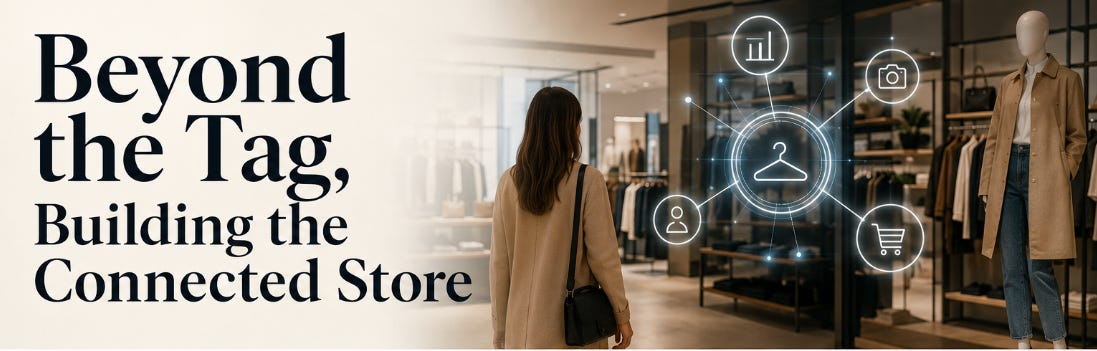
RFID has spent the last decade solving apparel’s inventory problem. But walk through the technology roadmap at almost any fashion brand in 2026 and RFID is now just one line item among several. Generative AI, computer vision, autonomous shopping agents and indoor sensor networks are reshaping how customers discover, try on and buy clothing, both online and on the sales floor. None of it depends on a chip sewn into a garment. Here is what else is defining the connected store this year.
AI virtual try-on has left the demo stage
For most of the last two years, virtual try-on was a promising but limited feature bolted onto a handful of e-commerce sites. That has changed. According to industry analysis from DLOOK, the virtual fitting room segment was valued at 4.79 billion dollars in 2023 and is projected to reach 25.11 billion dollars by 2032, and the broader virtual try-on technology market is forecast to grow from roughly 11 billion dollars in 2024 to over 100 billion dollars within the next decade. What used to require painstaking 3D modeling of every SKU is now largely automated. Diffusion and generative video models can render realistic fabric draping, shadow and movement from a handful of product photos, removing the traditional production bottleneck.
The physical store is catching up too. Smart mirror platforms like LOOOK.AI, built on real-time generative video models from the AI research lab Decart, let shoppers see an entire collection rendered onto their own body without any 3D asset production at all, both in storefront windows designed to pull in passersby and inside fitting rooms where customers can assemble outfits before ever touching a hanger. Eyewear and apparel brands using adaptive face and body mapping report meaningful reductions in return rates, since a shopper who has already seen roughly how a garment fits and drapes is less likely to order three sizes and send two back.
Shopping agents are becoming a real sales channel
The bigger structural shift is happening upstream of the store entirely. Shopping related searches on generative AI platforms grew by roughly 4,700 percent between 2024 and 2025, according to the McKinsey and Business of Fashion State of Fashion 2026 report, and fashion has emerged as one of the strongest categories for what the industry calls agentic commerce: AI agents that discover, compare and in some cases complete a purchase on a shopper’s behalf, without the shopper ever browsing a traditional product page.
This is no longer theoretical. Retailers including Coach, Kate Spade, Vuori, Revolve and the URBN family of brands are live on Stripe’s Agentic Commerce Suite, while Glossier and SKIMS sell directly through OpenAI’s Agentic Commerce Protocol inside ChatGPT. Ulta Beauty went live as a launch partner on Google’s competing Universal Commerce Protocol, alongside Macy’s, Wayfair and more than twenty other retailers and payment networks. Shopify reported that its Agentic Storefronts feature, which lets a single setup sell across ChatGPT, Perplexity and Microsoft Copilot at once, had expanded from roughly one million auto-enrolled merchants in October 2025 to 5.6 million stores by April 2026. Adobe’s Q1 2026 analysis of over a trillion US retail visits found that AI-referred shoppers convert 42 percent better than shoppers arriving through traditional channels, with fashion showing the largest year-over-year swing of any category.
For this to work, an AI agent needs to reason about fit the same way a salesperson would. Gap has partnered with Bold Metrics, a company that uses machine learning to predict more than fifty body measurements from a shopper’s height and weight and match them against fabric specific garment data, making Gap one of the first major retailers to offer in-chat size recommendations powered by AI. Bold Metrics has also introduced what it calls an Agentic Sizing Protocol, an API that lets any shopping agent query real-time fit data rather than relying on a brand’s generic size chart. The practical effect for a fashion brand is that its product catalog now has to be legible to a language model, not just to a human browsing a grid of thumbnails: accurate size, fit, material and availability data, structured and current, is quickly becoming as important as the photography.
Sensors and mapping are quietly rewiring the physical store
Away from the checkout, a separate layer of connected-store technology is focused on the building itself. Indoor mapping and IoT sensor networks, the kind increasingly deployed by mall operators and large-format retailers, now track foot traffic patterns, flag common navigation bottlenecks and identify which stores shoppers search for but never actually find. Smart shelf sensors and connected fixtures feed real-time occupancy and environmental data back to store operations teams, informing everything from staffing levels to which section of a store needs a layout change. Retail advisory firm Genpact has described this as the maturing of “phygital” retail, where augmented reality is layered directly into packaging, storefront windows and mobile apps rather than treated as a separate digital channel, blurring the line between browsing online and browsing in person.
Puma’s approach captures where this is heading. The brand is piloting a multilingual, AI equipped in-store concierge device at its Las Vegas flagship store, designed to answer product questions and guide shoppers through the store in real time, extending the same conversational shopping experience customers now expect from an AI browser tab onto the actual sales floor. Gap has taken a parallel path online, pairing predictive sizing with what it calls AI-native checkout built on Google’s Gemini models, aiming to remove friction at the two moments retailers say most reliably kill a sale: picking a size and completing payment.
Where this leaves apparel brands
None of these technologies is waiting for the others to mature. A shopper might discover a jacket through a ChatGPT recommendation, see it rendered onto their own body through a generative try-on tool, walk into a physical store that has already used sensor data to make sure that jacket is in stock and easy to find, and finish the interaction talking to an AI concierge rather than searching for a sales associate. Each piece works independently, but together they describe a shopping journey with far fewer manual steps and far less guesswork than the one apparel retail ran on even two years ago.
The common thread across all of it is data structure, not any single device. Agents need clean, current product attributes to recommend a brand by name instead of a generic search result. Virtual try-on needs accurate garment and fit data to render convincingly. In-store sensors need a digitized floor plan and inventory feed to route customers correctly. Brands that have already invested in clean product data and digital infrastructure, for whatever reason, are finding themselves unexpectedly well positioned for a shopping experience that is increasingly built and mediated by AI rather than browsed by a person scrolling a page.